Thousands Flee South as Fighting Intensifies Despite New Peace Deal
- Home
- Thousands Flee South as Fighting Intensifies Despite New Peace Deal
Thousands Flee South as Fighting Intensifies Despite New Peace Deal
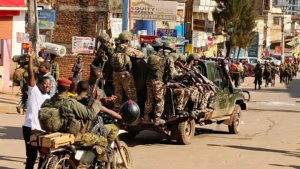
South Kivu, Democratic Republic of the Congo (DRC), 6 December 2025 — Thousands of civilians are fleeing southern areas of South Kivu province after violent clashes resumed — only days after the governments of the Democratic Republic of the Congo (DRC) and the Republic of Rwanda recommitted to a peace agreement in Washington. (Africanews)
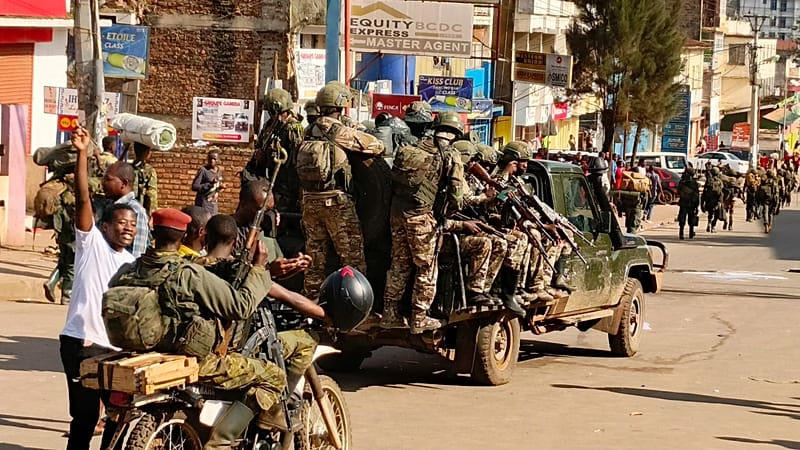
According to firsthand accounts, men, women and children — many carrying only a few belongings — began leaving their villages following heavy shelling and bombings in several zones, including around Luvungi, Katogota, and Kamanyola on the Ruzizi plain. (Africanews)
A resident of Luvungi, who fled with her children, told reporters: “Many people have died because of the bombings — we decided to leave today.” (Africanews)
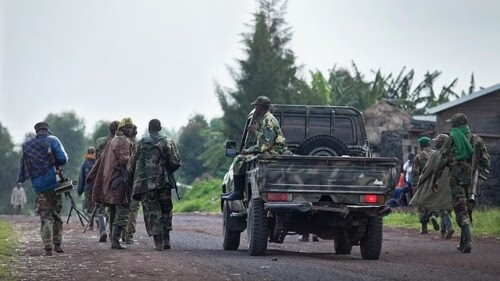
Local humanitarian authorities warn that the fighting — involving heavy artillery and indiscriminate shelling — has damaged homes, health centres and vital infrastructure, while displacement has surged across multiple territories including Uvira, Walungu, Kabare, Fizi and Kalehe. (The United Nations Office at Geneva)
Among those fleeing, over 700 Congolese reportedly crossed into Rwanda just 24 hours after the peace accord was signed — mainly women and children — seeking refuge in transit centres across the border. (Anadolu Ajansı)
The Peace Deal — And Why It Didn’t Stop the Violence
Last Thursday, DRC President Félix Tshisekedi and Rwandan President Paul Kagame signed a U.S.-brokered peace agreement in Washington aimed at ending years of conflict and establishing a ceasefire. (Africanews)
Dubbed by international mediators as a “historic” accord promising stability and peace in the war-torn eastern DRC, it was heralded as a turning point — offering hope for the region battered by conflict for decades. (AP News)
But within hours of the signing, violence erupted again between the government forces and the rebel M23 group, with both sides immediately accusing each other of violating the ceasefire. (Reuters)
Analysts now say the accord’s failure — so soon after signing — underscores deep mistrust, lack of enforcement mechanisms, and persistent underlying tensions that a paper agreement alone cannot resolve. (Financial Times)
Humanitarian Fallout — Who’s Suffering?
- Displaced families describe harrowing journeys — walking long distances, carrying children, few possessions, uncertain where to go; many arriving in transit camps or safer border zones. (Africanews)
- Critical civilian infrastructure has been damaged: home, schools, health centres shelled or destroyed; local medical facilities struggle to treat the wounded amid roadblocks and renewed fighting. (The United Nations Office at Geneva)
- The renewed wave of violence adds to already huge displacement numbers — as of end-October, around 1.2 million people were internally displaced in South Kivu, according to UN estimates. (United Nations)
Humanitarian agencies are sounding the alarm: urgent access is needed to deliver life-saving assistance. The explosion in displacement, casualties, and damage risks deepening what many regard as one of the world’s most severe crises. (The United Nations Office at Geneva)
What Comes Next? Uncertain Peace — Desperate Civilians
- The breakdown so soon after the peace signing raises serious doubts about the viability of the accord. Unless robust enforcement, monitoring and reconciliation mechanisms are deployed, peace remains fragile.
- Displaced populations will need long-term protection, shelter, healthcare, and humanitarian support — but continued conflict and restricted access make delivery difficult.
- The international community — especially mediators to the peace process — may face growing pressure to step up oversight, facilitate ceasefire compliance, and ensure safe corridors for civilians to flee or return home.
- For the thousands who have already fled, the urgent priority remains safety, provision of basic needs, and clarity about their future — whether internal displacement, refugee status, or eventual return home.
The sudden surge of displacement, coming just days after leaders publicly recommitted to peace, paints a grim picture: a reminder that signed treaties alone are not enough when on-the-ground loyalties, mistrust and security dynamics remain intense. For now, the civilians — already living through years of instability — bear the cost.
- Share

Direct Gist
Recent Posts
- Easiest Ways To Make Money Online That Actually Work (Without Skills)

- HostGator Web Hosting: The Trusted Hosting Solution Powering Over 9 Million Websites Worldwide

- Modern Conversations on Intimacy and Sexual Wellness in Africa

- E-Commerce Growth in Africa: How Digital Marketplaces Are Transforming Trade, Business, and Consumer Access

- Health & Wellness Trends in Africa: How the Continent Is Redefining Well-Being in the 21st Century

- Nudco Is Redefining Intimacy: Why Comfort, Confidence, and Sexual Wellness Belong in Everyday Conversations

- Thousands Flee South as Fighting Intensifies Despite New Peace Deal