
Côte d’Ivoire: A Growing Economy Despite Deep-Rooted Inequalities
- Home
- Côte d’Ivoire: A Growing Economy Despite Deep-Rooted Inequalities
Côte d’Ivoire: A Growing Economy Despite Deep-Rooted Inequalities
Abidjan, 26 November 2025 — Côte d’Ivoire remains one of the fastest-growing economies in West Africa. Strong GDP growth, rising investment, and economic diversification have cemented its status as a regional powerhouse. Yet, beneath the surface of prosperity, persistent structural inequalities — between urban and rural zones, between formal and informal workers, and across regions — continue to challenge inclusive development.
You may like to read: https://directgist.com/tanzania-cancels-independence-day-celebrations-after-calls-for-protests/
🔹 Economic Boom: What’s Fueling the Growth
- According to the Ivorian government and international institutions, Côte d’Ivoire’s real GDP growth reached 6.5% in 2023, and about 6.0% in 2024 — far above both global and sub-Saharan African averages. (economie-ivoirienne.ci)
- The medium-term outlook remains positive, with growth projected at 6.2% in 2025 and averaging ~6.4% through 2027 — driven by expansion in hydrocarbons, services, and private investment. (World Bank)
- The investment climate has improved substantially; Côte d’Ivoire has emerged as one of Africa’s top investment hubs, attracting both domestic and foreign capital. (Finance in Africa)
- Power and infrastructure expansion have been central. The “Electricity for All” programme, backed by the World Bank, boosted national grid coverage to nearly 94% of the population — a major enabler for industrial growth. (Finance in Africa)
- Traditional sectors such as agriculture (e.g., cocoa and cashew) remain important, but the government is increasingly investing in downstream processing and industrialization to boost value addition. (Finance in Africa)
- One of the most dynamic shifts is Côte d’Ivoire’s digital transformation strategy: the country is modernizing through digital infrastructure, services, and governance — digitizing tax systems, expanding digital finance, and promoting innovation. This has helped improve fiscal capacity, mobilize domestic resources, and drive competitiveness. (African Development Bank)
These gains have not only raised national output, but also improved living standards for many. The poverty rate, for example, fell from about 39.4% in 2018 to roughly 31.5% in 2025.
⚠️ But the Benefits Are Uneven: Inequality, Informality & Regional Gaps
Despite these economic successes, deep-seated inequalities continue to hinder truly inclusive growth:
- A large portion of economic activity remains informal — estimates show roughly 80% of non-agricultural employment is informal. This significantly limits access to social protections, stable incomes, and long-term economic mobility. (Africanews)
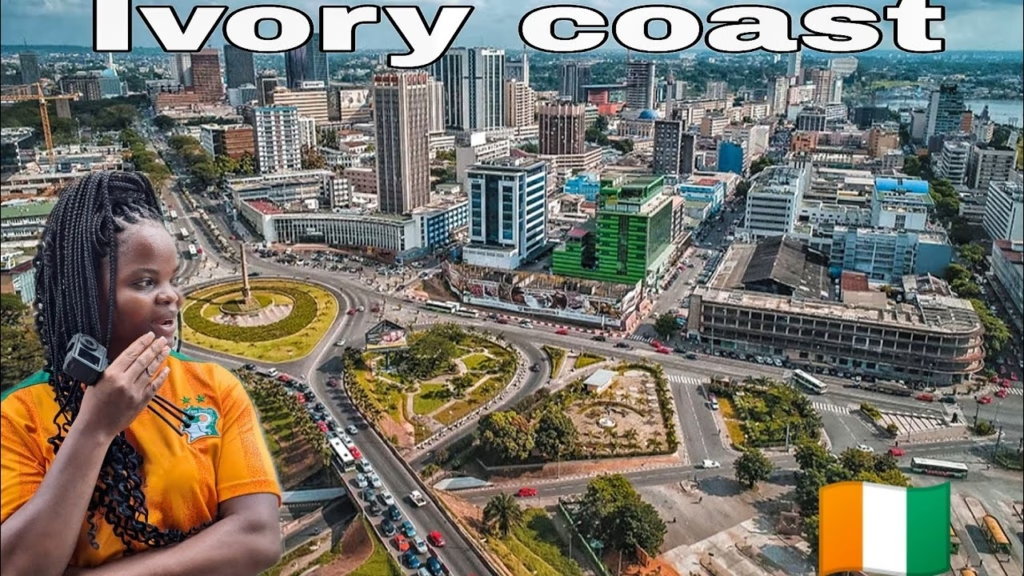
- The economy is highly concentrated in Abidjan, which reportedly accounts for nearly 90% of the country’s economic activity. (Africanews)
- There remain strong spatial inequalities: rural areas, which rely heavily on agriculture, often lag behind in access to quality services (education, health), infrastructure, and employment opportunities. (World Bank)
- While national poverty has declined, the gains are uneven. A substantial share of the population remains near or below the poverty line. (World Bank)
- Gender and social disparities persist, despite government efforts to promote equality and empower women. (IMF)
As a result, while Ivorian society is getting wealthier on aggregate, many people feel left behind — fueling frustration, especially among youth.
🧩 What Needs to Happen: Toward More Inclusive Growth
Experts and development institutions argue that for Côte d’Ivoire to translate macroeconomic success into long-term stability, policy focus must shift in several directions:
- Expand formal employment and social protection — by reducing the size of the informal sector, enforcing labor standards, and broadening access to benefits. This would help ensure rising incomes reach more households. (IMF)
- Invest in rural development and human capital — improving access to quality education, healthcare, and infrastructure outside Abidjan, reducing spatial inequality. (IMF)
- Promote value addition in agriculture & industry — through processing, agro-industrialization, and support for local enterprises, to capture more value locally instead of exporting raw materials. (Finance in Africa)
- Strengthen fiscal capacity and equitable tax systems — using reforms to mobilize domestic revenue and redistribute wealth more fairly. (World Bank)
- Advance digital and governance reforms — ensure transparency, fight corruption, and leverage digital tools to improve public service delivery and inclusion. (IMF)

📌 The Bottom Line
Côte d’Ivoire’s economic trajectory is undeniably impressive: consistent high growth, strategic investments, and diversification have made it a rising star in West Africa. But numbers only tell part of the story. The true test lies in whether that growth can be made inclusive, bringing real and lasting improvements to the lives of ordinary Ivorians — not only those in Abidjan or in the formal sector, but also rural dwellers, informal workers, and marginalized populations.
Without addressing structural inequalities, the economic expansion may deepen disparities and fuel social discontent — undermining long-term stability and threatening Côte d’Ivoire’s ambitions to become an upper-middle income country by 2030. As one expert noted in a recent analysis: “Growth does not automatically translate into shared prosperity.” (Africanews)
Related & Further Reading
- World Bank: Côte d’Ivoire Overview — data on growth, poverty, and structural reforms. (World Bank)
- AFDB / Côte d’Ivoire Digital Strategy — how digitalization is transforming agriculture, public services, and business. (African Development Bank)
- Finance in Africa: Côte d’Ivoire Among Top Investment Hubs — analysis of recent reforms, industrial growth, and investment trends. (Finance in Africa)
- IMF Report: Growth & Poverty-Reduction Strategy 2025 — assessment of macroeconomic stability, social challenges, and development goals. (IMF)
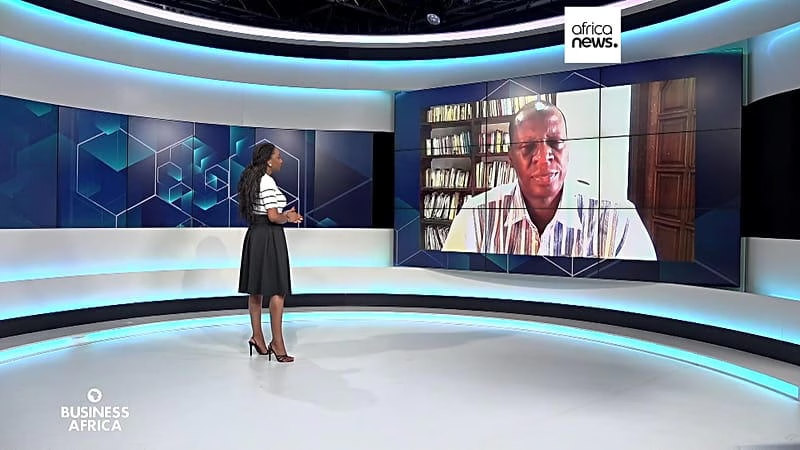
Côte d’Ivoire: a growing economy despite inequalities [Business Africa]
If you like — I can also pull up the latest statistics (2025) on unemployment, youth employment, income distribution, and regional disparities for Côte d’Ivoire to give your article more data-driven depth. Do you want me to build that for you now?
- Share

Direct Gist
Recent Posts
- Top 10 AI Tools Students Can Use to Learn Faster & Be More Productive in 2026

- How to Make Money Online as a Student in 2026 (Step-by-Step Guide)

- Top 10 Most In-Demand Jobs in 2026 (With Salary Insights & Career Paths)
- Best Free Online Courses in 2026 to Boost Your Career (No Payment Required)

- Top 10 High-Income Skills You Can Learn in 2026 Without a University Degree

- Lebanon Crisis Deepens as Mass Displacement Nears One Million Amid Escalating Conflict

- Ukraine War Forces Thousands of Children Into Underground Classrooms as Humanitarian Crisis Deepens