
Atiku demands annulment as Wike reasserts control
- Home
- Atiku demands annulment as Wike reasserts control
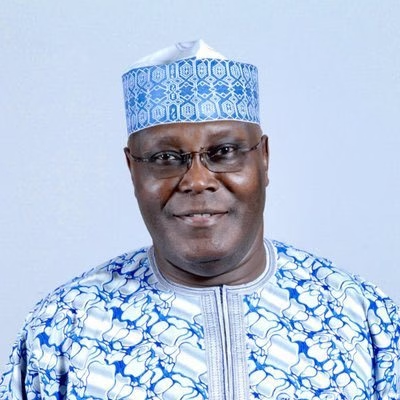
Atiku demands annulment as Wike reasserts control
The political equilibrium in Rivers State has once again experienced a significant shift, with the Minister of the Federal Capital Territory (FCT), Nyesom Wike, re-establishing his dominance over the state’s political grassroots. This follows a period of visible tension and competition between Wike and his political protégé-turned-rival, Governor Siminalayi Fubara, who had sought to consolidate authority over the state’s political structures in the past two years.
The Rivers State Independent Electoral Commission (RSIEC), under the new leadership of Dr. Michael Odey, on Sunday, August 31, announced the outcome of the local government elections held on August 30. The results revealed a sweeping victory for the All Progressives Congress (APC), which secured 20 out of 23 local government areas (LGAs), while the ruling Peoples Democratic Party (PDP) won the remaining three LGAs.
What was particularly notable was that both APC and PDP candidates who emerged victorious are widely regarded as loyalists of Wike, indicating his entrenched influence across party lines and political structures within the state.
Among the LGAs won by the APC are Obio/Akpor—Wike’s home LGA—Port Harcourt City, and Ogba/Egbema/Ndoni, underscoring strategic victories in politically and economically significant areas. Perhaps more strikingly, Governor Fubara lost his home LGA, Opobo–Nkoro, to the opposition APC, further highlighting the current tilt in political allegiance at the grassroots level.
Breakdown of Election Results
APC chairmanship victories included:
- Ofori Owolabi (Abua/Odual)
- Solomon Achoma (Ahoada East)
- Eugene Cheta (Ahoada West)
- Bob Fubarab (Akuku Toru)
- Otua Promise (Andoni)
- George Onengiyeofori (Asari Toru)
- Pepple Blessing (Bonny)
- Michael Williams (Degema)
- Obarilomate Ollor (Eleme)
- Lloyd Julius (Emohua)
- Njoku Chima (Etche)
- Confidence Deko (Gokana)
- Wobodo Charles (Ikwerre)
- Thomas Bariere (Khana)
- Dr. Gift Wodo (Obio/Akpor)
- Akuro Tobin (Okrika)
- Obasi Uchechukwu (Omuma)
- James A. James (Opobo/Nkoro)
- Okechukwu Nwogu (Oyigbo)
- Okwe Mbakpone (Tai)
The PDP victories came in:
- Chukwu Ogbodo (Ogba/Egbema/Ndoni)
- Vincent Nimieboka (Ogu/Bolo)
- Sir Allwell Ihunda (Port Harcourt)
In a striking political arrangement initiated under Wike’s previous administration and preserved in this electoral cycle, all chairmen-elect are men, while all vice-chairmen-elect are women, reflecting a gender-balance model across the 23 LGAs.
Criticism and Allegations of Electoral Irregularities
Despite RSIEC’s declaration of a peaceful and successful election, several stakeholders and observers have raised critical concerns over the credibility and legality of the electoral process.
Former Vice President Atiku Abubakar was among the first high-profile figures to denounce the exercise, describing it as “an awful absurdity and a travesty to the very notion of elective democracy.” In a statement posted on X (formerly Twitter), Atiku accused the federal government of manipulating the process for political gain and called on the international community to take note of what he described as a “dangerous curve” in Nigeria’s democratic trajectory.
“By the shameful and shambolic manner in which the occupation government went ahead to conduct local government elections in Rivers State, it is clear that the ruling APC party is not leaving anyone in doubt that it is prepared to throw caution to the wind to achieve an inordinate political advantage,” Atiku said.
He also urged all opposition parties in Rivers State to reject the outcome of the polls, stating that the entity that conducted the elections lacked legal and moral legitimacy.
Wike-Fubara Political Feud: Background and Fallout
The deepening rivalry between Wike and Governor Fubara can be traced back to late 2024, when Governor Fubara allegedly initiated moves to replace the then Speaker of the State House of Assembly, Martin Amaewhule—a known Wike ally—with a loyalist of his own. This was seen as an attempt to assert control over the legislative arm and tilt the balance of power in the state.
Before this rift, Wike had played a central role in Fubara’s emergence as governor, including the imposition of key political appointees—commissioners and aides—many of whom remained loyal to him. Tensions escalated when Fubara began sidelining these individuals and replacing them with his own loyalists.
The crisis peaked when a mysterious fire incident razed the Rivers State House of Assembly complex. This was followed by a failed attempt to impeach Governor Fubara. In response, the governor ordered the demolition of the Assembly complex and began governing with a faction of loyal lawmakers.
Presidential Intervention and Declaration of State of Emergency
In an effort to prevent further deterioration, President Bola Tinubu convened a meeting between the warring factions in Abuja, which led to the signing of a peace agreement. However, the truce proved short-lived as both sides failed to adhere fully to the terms.
The situation further degenerated, culminating in violent protests and threats from community and militant groups warning against the governor’s removal. The final straw was the attack on a critical oil infrastructure linked to the Trans Niger Pipeline, which prompted the federal government to declare a State of Emergency in Rivers State in early 2025.
President Tinubu, invoking emergency powers, suspended Governor Fubara, his deputy Prof. Ngobi Odu, and the entire state legislature. Vice Admiral Ibok-Ete Ibas (retd.) was appointed as the Administrator of Rivers State with an initial six-month mandate, set to expire on September 18, 2025.
Ibas swiftly removed local government caretaker appointees earlier installed by Fubara and also replaced the leadership of RSIEC, which had been under Justice Adolphus Enebeli (retd.), a Fubara appointee. Under the new leadership of Dr. Odey, the August 30 local government elections were conducted.
Controversy Over Legality of the Election
Legal experts and political stakeholders, including elder statesman High Chief Sunnie Chukumele, argue that the elections may be legally null and void, citing a recent Supreme Court ruling which nullified a similar RSIEC-organized election for failing to comply with the 90-day constitutional notice required by law.
“You cannot build something on nothing,” Chukumele stated. “This is an aberration and contemptuous of the Supreme Court’s judgment. It will not stand the test of legal scrutiny.”
Former lawmaker Hon. Ogbonna Nwuke also questioned the legitimacy of the election based on visible voter apathy versus the outcome, suggesting that the declared results may not reflect the actual will of the people.
Implications and Outlook
While the latest developments appear to tilt the political balance in favour of Nyesom Wike, analysts warn that the situation remains volatile. With legal challenges likely to emerge, and Governor Fubara’s suspension potentially nearing review, the next phase of Rivers State’s political evolution could once again reshape its power structures.
Observers are also watching closely to see whether President Tinubu will extend the emergency rule, lift the suspension of elected officials, or pave the way for fresh elections and reconciliation.
The stakes remain high in Rivers State, not only due to its political weight but also because of its critical role in Nigeria’s oil economy and national cohesion.
- Share

Direct Gist
Recent Posts
- Top 10 AI Tools Students Can Use to Learn Faster & Be More Productive in 2026

- How to Make Money Online as a Student in 2026 (Step-by-Step Guide)

- Top 10 Most In-Demand Jobs in 2026 (With Salary Insights & Career Paths)

- Best Free Online Courses in 2026 to Boost Your Career (No Payment Required)

- Top 10 High-Income Skills You Can Learn in 2026 Without a University Degree

- Lebanon Crisis Deepens as Mass Displacement Nears One Million Amid Escalating Conflict
- Ukraine War Forces Thousands of Children Into Underground Classrooms as Humanitarian Crisis Deepens